Tuesday, November 1, 2011

Time to raise the speed limit on Route 3

Speed limits are good things.  Speed limits make our roads safer.  The Massachusetts Highway Department, in its 2005 “Procedures for Speed Zoning on State and Municipal Roadways,” makes this highly persuasive argument. “The principal benefit of properly established speed zoning is to provide a means for police officers to apply enforcement to those who do not conform to speeds considered reasonable and proper by the majority of the motoring public. Public opinion will be on the side of the police who are enforcing a reasonable maximum speed.  The former federally mandated 55 mile per hour national speed limit on the Interstate System clearly shows that an unreasonably low speed limit is neither enforceable nor has the long term support of the general public.”

So, why is the speed limit on U.S. Route 3 still set at 55 miles per hour?

Clearly, the current speed limit on Route 3 cannot be supported by the procedures for setting speed limits outlined in the state’s own document.  According to the state, “a prerequisite to establishing speed regulations… is a comprehensive engineering study.”  The goal of the study is to “establish a speed limit that is safe, reasonable, and self-enforcing.” 

The engineering study is based on the assumption that 85% of people, left to their own devices, will drive at a safe and reasonable speed over a stretch of highway.  The people who are flying past 85% of the traffic are the drivers who are not conforming to a reasonable and proper speed, and should be subject to police enforcement.  The state procedures manual explains that, “this method is based on numerous studies that indicate that the majority of motorists are prudent and capable of selecting safe speeds.”  The state further explains that this method “is the national standard for establishing safe speed limits.”

State procedures for speed checks specify measurements on “average weekdays at off –peak hours and under ideal weather conditions.”  As a Route 3 commuter, I don’t have the radar gun or laser gun specified by the state engineers for the purposes of collecting data on vehicular speed.  However, I do have a car, and I can sit in the middle lane, choose a speed, and observe the traffic around me.

Driving 55 miles per hour in the middle lane of Route 3 makes one feel like a boulder in the middle of a stream.  Cars, trucks, school buses, practically the entire world is moving right or left to avoid the mid-stream obstruction.  It’s easy to tell that you are not traveling faster than the federal standard of 85% of the other drivers; you are lucky to be traveling faster than two percent of the drivers on the road.

Speed up to 65 miles per hour, and you are passing some slower drivers, but you are also being passed by an equal number of drivers.  I suspect that 65 miles per hour is somewhere in the middle of the distribution of highway speeds, nowhere near the 85%ile requirement for setting a speed limit.  You need to speed up to about 75 miles per hour before you get the sense that you are one of the faster cars on the road, and still there are enough people passing to think you haven’t cracked the 85% threshold.

Clearly, the Route 3 speed limit does not conform to state and federal standards.  While this is the most egregious case in the Commonwealth, it is not unique.  The state legislature adopted a 65 miles per hour maximum in 1992, following the repeal of the nationally-mandated 55 miles per hour limit. The state bureaucracy, however, did not see fit to raise speed limits.  The legislature forced the issue in 1996, when it enacted legislation that set the speed limit on 400 miles of highways to 65 miles per hour.

At that time, Route 3 was left off the list of highways for legislative intervention because it was still a narrow, four-lane road that threaded its way between lots of rocky obstacles.  Since then, Route 3 was widened to six lanes, the rocky median has been removed, and we now have a road with wide lanes, gentle curves, and expansive sight lines.  Despite its extraordinary design, the road is stuck with an unreasonably low speed limit that is neither enforceable nor has the long term support of the general public.

A legislative remedy is at hand. A bill has been introduced by Representative Sean Garballey (H-914) and Senator Kenneth Donnelly (S-1734) to add Route 3 to the list of legislatively-mandated 65 mile per hour zones.  Given the state bureaucracy’s refusal to follow its own procedures for setting a speed limit on Route 3, this legislative action is necessary to allow safe and reasonable drivers to conform to a more reasonable speed law.  Let’s hope the general court acts on this common-sense legislation soon, and brings some regulatory reasonableness to this important highway.


IMAGES:  A 2005 Massachusetts Highway Department interoffice memorandum, recommending a 65 MPH speed limit on Route 3.


Sunday, October 9, 2011

Solving the Designated Hitter problem for MLB

MLB is looking at realignment. Now that inter-league play has become a part of the game, MLB is looking at balancing the leagues and divisions.

Right now, there are 30 teams in Major League Baseball, 16 in the National League and 14 in the American League. There are six teams in the NL Central, four teams in the AL West, and five teams in the other divisions. NL Central fans don't like this (you need to beat out five teams to win the division), and it makes it easier for an AL West team to win the division (you only need to beat out three other teams).

Even numbers are important when building a schedule, as you need two teams to hold one game. If there are an odd number of teams, one team must be left on the sideline on any given day. That's why you can't just move a NL team to the AL, balance out the divisions, without changing the schedule.

You could have an odd number of teams in each league if there is at least one inter-league game on any given day. Instead of a cluster of inter-league games in the middle of the season, there would need to be a minimum of 162 inter-league games spread out across the year. Mathematically, each team (assuming two 15-team leagues) would need to play a minimum of 12 inter-league games to make realignment work. (Presently, in the American League, each team plays 18 games. In the National League, teams play from 12-18 inter-league games, for a total of 252 inter-league games.)

Some folks hate inter-league play, and I understand their arguments. However, I see the benefits, as Cubs-White Sox, Yankees-Mets, Dodgers-Angels, Giants-Athletics, and other cross-league geographic rivalries are good for the game. I also hate 10:05 p.m. starts on the west coast. As a loyal fan of our Red Sox, I am happy when we play the Cubs, Pirates, Phillies, Nationals, or any other NL team where it's easy to do a quick road trip to see my beloved team. Besides, as a lefty progressive, it is certainly green to replace trips to the west coast with games against more local rivals.

More east coast games? Less travel to the west coast and fewer 10:05 p.m. starts? What could be bad? What's the problem?

The DH.

Yes, the Designated Hitter rule in the AL makes things difficult for AL teams in NL ball parks. We truly can't make inter-league play work if there are two sets of rules. You can't build an AL team around a DH if you can't use him for six, nine, or twelve games (or more) during the season.

National League fans, however, have a valid reason for resisting the DH. National League games are filled with double switches and all kinds of interesting strategy surrounding a pitching change. They are right. It's lots more fun to watch a game when pitching changes have an impact on the lineup.

My solution is a modified DH rule that would apply to both leagues.

Instead of the current rule, where the DH position substitutes for the pitcher's position in the lineup, let's have the DH substitute for A pitcher. Simply stated, as long as the starting pitcher is in the game, the DH can bat for him. Once you remove the starting pitcher from the game, the DH who was batting in his place is also out of the game.

There are lots of potential impacts to the game by having a modified DH. The trend in many AL teams, where the DH is a way to rest a position player, would be supported by the change. Chances are, if you have a really good DH, you would put him in the first slot on the batting order, giving him more at bats in a game. There are lots of other potential implications for managerial strategy, and I think the game would be better for the change. In both leagues.

So, let's get the Modified DH movement going!

Sunday, May 30, 2010

We have the technology - Why doesn't the MBTA use it?

Thursday night, we were returning home to Arlington from a Red Sox loss to the Kansas City Royals. I took out my iPhone and looked at a most wonderful app called Mass Transit to check the schedule for the 77 bus from Harvard to Arlington Heights. The bus was scheduled to depart at 11:03, and we were pulling into Harvard Station at 11:00, so it looked like the transit gods were in a better mood than the baseball gods.


As we exited the train, these excellent T digital displays (complete with clocks) were just flipping from 11:00 to 11:01, flipping at the same time as my cell phone. Piece of cake. A very short walk to the busway, hop on the bus, and we will be home to see the painful report on the local news of our choice.

However, as we walked through the turnstiles, we could see the 77 bus passing through the busway. The bus was gone before the T-clocks flipped to 11:02. The next bus was 11:16. We were now stuck with a 14 minute wait for a bus.

The 74 bus to Belmont came through the busway. It was scheduled to leave at 11:00, and I am sure the half-dozen people who came off the 11:00 Red Line train and boarded the bus were delighted that their bus was three minutes late.


This gave me some time to stand there and play with the Mass Transit app, and I quickly did a little math. The 77 bus runs at a 13 minute interval, but the Red Line runs at a 12 minute interval. The loudspeakers in the station announced an inbound train, and an Alewife bound train came through at about 11:12. The people on that train wandered up to the bus platform. At 11:17, a 77 bus appeared in the busway and the people on the platform filled the bus.

Here's my public policy question. If my iPhone can tell me the schedule, and the T technology can send an announcement that a train is entering the station, why can't we bring the two technologies together to coordinate the buses with the trains?

First, let's look at the 13 minute headway silliness on the 77 bus. If the trains run every 12 minutes, why do the buses run every 13 minutes? All this does is put the schedules so badly out of sync that some folks might be lucky and wait a minute or two for the bus, but others are condemned to a 12 minute wait.

If we put the bus on the same 12-minute headway, here's the wonderful thing we can do. We can calculate the time the outbound train is scheduled to arrive at the station, add three minutes for the walk to the platform, and time the buses to provide an easy and convenient transfer.

Meanwhile, up at the bus layover area, the same computer that sends the notification to the passengers on the platform could also send a signal to the bus driver. Train leaves the station, buses are called, and they pick up the passengers who just walked off the train.

For the buses with longer headways, the buses could leave on a multiple of 12 (or the interval between trains). With this kind of coordination, an Arlington passenger could actually calculate whether the best option would be to connect with a 77 at Harvard, an 86 at Davis, or a 79 or 350 at Alewife. A Burlington-bound rider could actually calculate which outbound Red Line train he needed to be on to connect to the 350 at Alewife. A new Green Line station at Route 16 in Medford would be much more useful if buses to Arlington and Medford were coordinated.

And so it goes for the rest of the system. Quincy, Forest Hills, Wellington, Wonderland, all could be more transit-friendly, and less dependent on parking garages, if the buses were aligned to the trains.

It doesn't seem to be a terribly difficult problem to solve. So why don't we actually do this?

Thursday, November 6, 2008

Blue England

Have you ever been to Piscataquis County, Maine? It is one of the largest counties (in area) east of the Mississippi River. Baxter State Park and Moosehead Lake are in Piscataquis County. Despite its huge size, this county has less than half the population (17,235) of Arlington. Piscataquis County is the only county in the six New England states that was carried by John McCain. (Yes. That means Barack Obama carried every county in New Hampshire.) McCain won Piscataquis County by 355 votes, 4,785 4,430. Consider there are 67 counties in New England, and Barack Obama carried 66 of them. McCain carried a tiny county by 355 votes. Welcome to Blue England.

New England elects 22 members of the House of Representatvies. With the defeat of Christopher Shays in Connecticut, all 22 members will be Democrats. This is amazing, when you consider that it wasn't long ago when New England was the most reliably Republican region in the country. In 1932, New England provided four of the six states (ME, NH, VT, CT) voting for Herbert Hoover over FDR. (The other two states were PA and DE.)

Every action has an equal and opposite reaction. The rise of the Republicans as a predominantly socially-conservative and southern party conflicts with the socially-tolerant but frugal nature of New Englanders.

If the 2008 elections prove anything, good old New England common sense seems to be spreading. Not only are we solid blue, but the colors are running south and west. How far? Here's two examples.

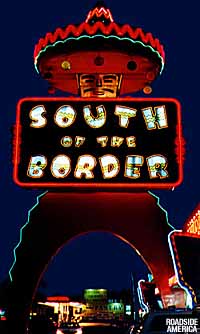
If you have ever driven south on I-95 toward Florida, you know the signs for South of the Border start appearing after you pass Washington. This famous tourist stop is just south of the North Carolina-South Carolina border. According to Google Maps, it is 816 miles, more than 13 hours of driving time, south of Arlington. If President-Elect Obama maintains his lead in North Carolina, South of the Border will be at the bottom of the first exit on I-95 in the first red state you encounter on your southbound trip.

If south isn't your preferred direction, you can head west on I-90. Head west and you will be driving through beautiful blue Obama states until you reach Brandon, SD. It's the first town in the first red state on that westbound trip. It's 1,545 miles and about 24 hours west of Arlington.

It's nice to know the next president, and the majorities of both houses of Congress, share our values. I look forward to some good old-fashioned Blue England common sense reflected in our new government.

Tuesday, November 4, 2008

Making history


This is an emotional and historic day. I keep looking back to 1968, the last time our nation was on a terribly wrong track, and it seems that we lost lots of hope for America with the loss of Martin Luther King and Bobby Kennedy. Today, I can feel that hope, that the dreams of the past were merely dreams deferred.

Sunday, November 2, 2008

The Cohen-Langhart Effect

The polls show Barack Obama leading by a large margin in Virginia, and is flirting with a lead in North Carolina.

What's going on here? The Democrats have nominated a pair of liberals, neither of them are southerners. These states have large military populations and a history of voting for Republicans in presidential elections. North Carolina elected Jesse Helms to the United States Senate in 1972, 1980, 1986, 1992, and 1996.

It may seem counterintuitive, by my hypothesis is that the military population is a significant key in this shift. Despite John McCain's military service, and his outreach to military voters, could there be some other effect that is moving this population toward Obama?

Could there be a Cohen-Langhart effect?


It may seem counterintuitive, by my hypothesis is that the military population is a significant key in this shift. Despite John McCain's military service, and his outreach to military voters, could there be some other effect that is moving this population toward Obama?

On July 26, 1948, President Harry S. Truman signed Executive Order 9981, ordering "equality of treatment and opportunity for all persons in the armed services without regard to race, color, religion or national origin."

As a result, we have a military that has become a the most colorblind meritocracy in the nation. It's the norm to live in an environment where rank, not color, defines hierarchy, where people routinely work and live with people from diverse backgrounds, and where looking up the chain of command involves people of many colors.


Racial lines have faded in the military to the point where rates of interracial marriage are significantly higher in the military than in the population at large. At the conclusion of the Clinton administration, this included Defense Secretary William Cohen and "First Lady of the Pentagon" Janet Langhart.

Barack Obama is a candidate to become Commander in Chief, and the military looks at a son of an African father and white mother and sees nothing unusual. While he doesn't look like any of the dead presidents, he does look like someone who belongs up the military chain of command.

When we count the votes, look at individual precincts and exit polls, I suspect we are going to find that Barack Obama will do very well among a military population that has traditionally been GOP-friendly.

Friday, October 31, 2008

Yes on 3: Dogs against corporate welfare

An editorial in the New Bedford Standard-Times presents the argument that I believe is central to the discussion of Question 3. Greyhound racing is an industry that is sinking deeper into the corporate welfare system, and this ballot question is a way to end the suffering of dogs and Massachusetts taxpayers.
Two greyhound tracks remain open: Raynham Park, right here in Bristol County, and Wonderland Greyhound Park in Revere.

Money gambled at the tracks has declined substantially in recent years, dropping 37 percent in Raynham and 65 percent in Revere between 2002 and 2007. Officials from both tracks have said they will go out of business soon without state intervention, and they are asking for slot machines to shore up their revenue.

The editorial continues:
Raynham Park owner George Carney's own testimony at a legislative hearing last year revealed how tracks would fare without state help: "I'm telling you there's no money left in the racing. If you want to keep us going, you've got to give us the slots," the Boston Globe quoted him saying.

So without slot parlors, the dog tracks would fail. And why bail them out?


If I want to watch greyhound races, I'll sit alongside the Mass Pike.

Thursday, October 23, 2008

The ultimate undecided voter


A car parked in the center of Lowell, Massachusetts, is sending mixed messages about the 2008 presidential race. This Camry, parked across the street from Lowell High School, has a McCain bumper sticker AND an Obama bumper sticker.

Saturday, October 11, 2008

Wheels coming off the Straight Talk Express


Sitting in beloved Arlington, Massachusetts, it's tough to get a feel for national politics. We are one of the bluest towns in one of the bluest states, so when it feels like everyone is for the Democrat, it comes as a surprise when the results turn out differently.

Four years ago, it seemed as if every other car in town had a Kerry-Edwards bumper sticker, and the line at the polls was deep with indignant people who couldn't wait to rid our beautiful nation of the shrub in the White House. Eight years ago, Arlington gave Al Gore a bigger plurality (9,494 votes) than Bush's margin of victory in Florida (537 votes) or New Hampshire (7,211 votes). Think about it. If we could have somehow gerrymandered Arlington into New Hampshire, Gore would have been elected president.

That said, it's hard to ignore evidence of wholesale abandonment of the McCain campaign from the rest of the country. From Jay Severin to William F. Buckley's kid, they're running away from the McCain train wreck.

My first sign of trouble on the McCain horizon came the day Sarah Palin was announced as the GOP VP choice. The one-two punch of Obama's speech and McCain's choice of an unqualified running mate was too much for my Republican parents. Granted, they are the kind of northeastern moderates who were comfortable in a party of Nelson Rockefeller, Lowell Weicker, or Thomas Kean. They are for fiscal responsibility, but against the social conservatives who want to infuse religious beliefs into governance. They were the kind of Republicans who loved the 2000 McCain, and probably voted for him in the 2008 primary. After that conversation, I sent them two Republicans for Obama bumper stickers.

With less than four weeks to the election, the McCain exodus is booming. Christopher Buckley, the son of William F. Buckley Jr., wrote a column this week with the message: Sorry, Dad, but I'm voting for Obama.
But that was—sigh—then. John McCain has changed. He said, famously, apropos the Republican debacle post-1994, “We came to Washington to change it, and Washington changed us.” This campaign has changed John McCain. It has made him inauthentic. A once-first class temperament has become irascible and snarly; his positions change, and lack coherence; he makes unrealistic promises, such as balancing the federal budget “by the end of my first term.” Who, really, believes that? Then there was the self-dramatizing and feckless suspension of his campaign over the financial crisis. His ninth-inning attack ads are mean-spirited and pointless. And finally, not to belabor it, there was the Palin nomination. What on earth can he have been thinking?

Then there's former governor William Milliken (R-Michigan), who is clearly displaying backup lights in the Grand Rapids Press.
GRAND RAPIDS -- He endorsed John McCain in the presidential primary, but now former Republican Gov. William Milliken is expressing doubts about his party's nominee.

"He is not the McCain I endorsed," said Milliken, reached at his Traverse City home Thursday. "He keeps saying, 'Who is Barack Obama?' I would ask the question, 'Who is John McCain?' because his campaign has become rather disappointing to me.

"I'm disappointed in the tenor and the personal attacks on the part of the McCain campaign, when he ought to be talking about the issues."

The article continues:
Milliken stopped short of saying he will vote for Obama, but said he differs with McCain on the Iraq war and his choice of Palin.

"I know John McCain is 72. In my book, that's quite young," said Milliken, 86, Michigan's longest-serving governor. But he added, "What if she were to become president of the United States? The idea, to me, is quite disturbing, if not appalling.

"Increasingly, the party is moving toward rigidity, and I don't like that. I think Gerald Ford would hold generally the same view I'm holding on the direction of the Republican Party."

And then again, there's Jay Severin. No, he's not on the Obama bandwagon. Far from it. Jay is just saying McCain is a loser, and it's more fun to vote for Bob Barr. The theme seems to be that Obama is going to win anyway, so the right might as well vote for a real libertarian-conservative as opposed to whatever McCain has become.

Clearly, McCain's actions of late have eroded his core support. For everyone who admired the old McCain, this version is too-Bushy, too inauthentic, too nasty, and not presidential enough to earn a vote. Those are verdicts that are hard to escape, and negatives that are hard to overcome.

Thursday, October 2, 2008

Bring back the Pacific Coast League

I grew up in a world in which Satan, Osama Bin Laden, and the entire Axis of Evil were beloved compared to Walter Francis O'Malley, who moved the Brooklyn Dodgers to Los Angeles. Suffice it to say, I have a natural born prejudice against Major League Baseball on the west coast.

That bias is reinforced by last night's American League playoff game, in which the Boston Red Sox visited (and beat) the Los Angeles Angels of Anaheim. It was a triumph of good over evil, but our joy came well after midnight. The game started at 10:00 p.m. Eastern Time.

Many old-time sports purists lament inter-league play. For some, the sight of Yankees-Mets or White Sox-Cubs outside of a World Series is sacrilege. I don't see how that's bad for baseball. People really love these games, they fuel intense local rivalries, and they never have a 10:00 p.m. starting time.

As a loyal member of Red Sox nation, where the local ballyard has been sold out for years and fans are held hostage to ticket brokers, a road trip is often the cheapest way to see our beloved team. Baltimore, Chicago, and Tampa Bay are favorite destinations for Red Sox Nation road trips, and the home team radio announcers routinely bemoan the predominance of Red Sox cheers in their home ballpark. Inter-league play has added Philadelphia to the list of Red Sox Nation tourist destinations, and I am sure the convention and visitors bureaus of Washington, Pittsburgh, and Cincinnati would be appreciative of a similar influx of New Englanders.

It's not that I have anything against westward tourism. Trips to the west coast can be fun, and the half-empty stadium in Oakland is a particular draw for a nice Red Sox vacation. However, the west coast teams love night games, and a Pacific Time 7:05 start is a 10:05 start in New England. This late start presents a troublesome conflict between religious obligations and the sleeping patterns of the Red Sox faithful.

It's time to bring back the Pacific Coast League.
It's very nice that the left coast has baseball, but why should it get in the way of the righteous practice of the national pastime in the cradle of baseball civilization? Why should the westward migration and expansion come at the expense of starting times beyond east coast bedtimes?

If they want to have Major League Baseball in places like California, Washington, and Arizona, why can't they have a league of their own? They could happily start their games at any time of the day or night, and nobody east of Kansas will care. Cutting down on the cross-country road trips will also reduce the carbon footprint of Major League Baseball, as a road trip from Baltimore to Washington or Philadelphia is a quick train ride instead of a jet-fuel sucking shlep to Oakland or Seattle.

If Major League Baseball doesn't want to realign the sport, to rid us of those west coast trips, they should consider a New Rule: Baseball games may not start later than 8:00 p.m. in the visiting team's television market. Is it too much to ask that, when the west coast team hosts a team from the east, the game should be scheduled so the fans of the visiting teams can enjoy the game on television? I think not.

Of course, the selfish westerners won't want to make any sacrifice for the good of the game, or at least the east coast fans. Why should they? We don't play our home games when their fans are sleeping. Unless, of course, we start a new tradition of East Coast Breakfast Baseball. If eastern clubs schedule a bunch of 8:00 a.m. starts when we host Pacific teams, we can beat bleary-eyed and jet-lagged Angels and Mariners with ease before their fans even wake up. A single season of morning games will cause the crisis that prompts a great compromise: we won't hold morning games for western teams if the western teams won't start their games with eastern teams later than 8:00 Eastern, 5:00 Pacific.

Cranky and sleep deprived, the best I can do today is to happily await the rapid elimination of the Angels and Dodgers from playoff contention. With any luck, Friday night's late start will be the last we need to endure.

Thursday, September 25, 2008

Chicken Fried McCain

The clairvoyant blog shakesville posted today's photo on December 31, 2007.

Having discovered the disaster excuse for avoiding unpleasant events, when a hurricane in the Gulf of Mexico provided cover for George W. Bush and Dick Cheney's RNC vanishing act, McCain's at it again.

From the day McCain announced Sarah Palin's place on the ticket, to the last day of the "lipstick on a pig" debate, the red line was increasing, and the blue line was slumping. Then, suddenly, Wall Street started to sink beneath the alligators in Manhattan's sewers. We forgot about the sideshows, and started talking about a real live national issue, and the trend line took a sharp turn back to blue.


John McCain looked ahead in the schedule, and saw a debate on the horizon. Recognizing that a debate would likely focus on issues, and any discussion of issues makes the little red line on the chart head south, he is now attempting to use the "hurricane ate my homework" excuse to avoid the whole thing.

Come to think about it, the mere act of campaigning has been problematic for the McCain campaign. If you go out among the people and campaign, and the act of campaigning depresses your polling numbers, suspending all campaigning would seem to be an excellent strategy.

But why stop there? Why just suspend the campaign? We could suspend the election, too. I mean, if the Republicans want four more years just like the last eight years, suspending the entire political process is just the ticket.

Saturday, September 20, 2008

Palin's porky $26 million Gravina road to nowhere

Sarah Palin was for the Bridge to Nowhere (linking Gravina Island to Ketchikan) before she was against it. The access road is another story. According to the LA Times, the death of the bridge had no impact on the health of a 3.2 mile access road.

The road to nowhere, which is still being built, was originally intended to connect the airport on Gravina Island to the infamous Bridge to Nowhere. This dead-end highway is being built on an island with a population of 50, and sans-bridge it will end at a cul-de-sac across the Tongass Narrows from Ketchickan.

The mayor (of Ketchikan, Bob Weinstein) said he was considering posting a sign on the road for the rest of the world to see. He said it would read: "Built Under Gov. Sarah Palin, Paid for With Federal Earmarks."


The road to nowhere, under construction.

Monday, September 15, 2008

Massachusetts needs new license plates


There is only one state in the union with older license plates on the street than Massachusetts. Our green license plates date back to 1977, which means there are cars on the street with 31 year old plates.

This presents a problem that goes beyond the wear and tear that fades and cracks a 31-year-old piece of aluminum in harsh New England weather. If you don't retire the old plates, and restart a new series of plates, you exhaust many millions of available letter-number combinations.


Consider the math. The first series of license plates had three letters and three numbers, and the first digit was never a 0. The letters I, O, and Q were never used.

For math geeks, these rules create 12,167 different letter combinations. Each three digit number can generate 900 plates (numbers 100-999), so the 12,167 letter combinations generate 10,950,300 possible plates.

When Massachusetts exhausted the three-letter three-number combinations, they simply reversed the order, generating another 10,950,300 possibilities. In 1987 the Registry started manufacturing the red "Spirit of Massachusetts plates, and they stopped issuing the green plates in the early 1990s.


Soon after the red plates began to appear, the NNNLLL combinations were exhasted, and the state went to a series of two letter - four number plates. Given the same rules, four number-two letter plates generate 4,761,000 combinations. Reversing the order generates another 4,761,000 plates. Those combinations were exhausted, and the state then placed the two letters in the middle of the number combination. That generates another 4,761,000 plates.


This numbering scheme is now exhausted, and we appear to be going to a scheme of three digits, two letters, followed by another number.


This now results in a combination where a plate can now be 123 LD0, where the last character is the number zero. (Someone familiar with the Massachusetts registration scheme can tell the last digit is a zero and not the letter O because the plate expires in October, not January.) This creates confusion in 10% of the plates distributed under this new scheme. In addition, having multiple (and increasingly complicated) schemes makes it more difficult to remember a plate number in an emergency.


Plus, as an extra bonus, the first generation of red plates is aging to the point where they are fading like the old greenies.

So, here we are in a state of 6.4 million people, and we have exhausted more than 37 million possible plate combinations (including the 900,000 number-only plates from 100000 to 999999).


Massachusetts issued new plates every year prior to 1949, when the state issued new plates every two years. In 1967, the state went to undated plates (blue on white), then red on white (around 1972), replaced by the current green on white starting in March, 1977.

What should new plates look like?

Given that we need to retire the red and the green plates to reuse the 37 million combinations that are exhausted in the current scheme, we need to change the color of the plate and possibly devise a new design. The state police have already converted to new plates with blue characters.


Some states have incorporated art into their plates, and that's not a bad thing. Massachusetts was one of the first, incorporating our sacred cod into the 1928 plate. Perhaps it is a time for it to return, now that the technology for artistic enhancements has improved.


The Spirit of Massachusetts is the Spirit of America?
It was a state tourism promotion that dates back to the Dukakis administration, but half of this slogan lurks on our license plates today. I doubt it does little to promote tourism. Maybe we don't need a slogan on the plates, but if we place something on our plates it should be something that actually sells the state. I'll happily leave that to the imagination of BMG readers.

Tuesday, September 2, 2008

Being a Progressive (in 1912)

It seems that the Republican convention is looking to invoke Teddy Roosevelt in support of the McCain-Palin ticket. Historians will note, however, that Teddy Roosevelt was a 1912 Progressive, and judging from the 1912 Progressive Party platform, it's strange that McCain and Palin are trying to abandon the Republican label for the Teddy Roosevelt Bull Moose Progressives.

The 1912 Progressive Party platform is posted here. Below the bull moose, you will find three planks. 96 years later, do you think either McCain or Palin are on board for the beliefs of Teddy Roosevelt and his breakaway party?

Don't let McCain-Palin turn a Progressive hero into moose stew!


SOCIAL AND INDUSTRIAL JUSTICE
The supreme duty of the Nation is the conservation of human resources through an enlightened measure of social and industrial justice. We pledge ourselves to work unceasingly in State and Nation for:

Effective legislation looking to the prevention of industrial accidents, occupational diseases, overwork, involuntary unemployment, and other injurous effects incident to modern industry;

The fixing of minimum safety and health standards for the various occupations, and the exercise of the public authority of State and Nation, including the Federal Control over interstate commerce, and the taxing power, to maintain such standards;

The prohibition of child labor;

Minimum wage standards for working women, to provide a "living wage" in all industrial occupations;

The general prohibition of night work for women and the establishment of an eight hour day for women and young persons;

One day’s rest in seven for all wage workers;

The eight hour day in continuous twenty-four hour industries;

The abolition of the convict contract labor system; substituting a system of prison production for governmental consumption only; and the application of prisoners’ earnings to the support of their dependent families;

Publicity as to wages, hours and conditions of labor; full reports upon industrial accidents and diseases, and the opening to public inspection of all tallies, weights, measures and check systems on labor products;

Standards of compensation for death by industrial accident and injury and trade disease which will transfer the burden of lost earnings from the families of working people to the industry, and thus to the community;

The protection of home life against the hazards of sickness, irregular employment and old age through the adoption of a system of social insurance adapted to American use;

The development of the creative labor power of America by lifting the last load of illiteracy from American youth and establishing continuation schools for industrial education under public control and encouraging agricultural education and demonstration in rural schools;

The establishment of industrial research laboratories to put the methods and discoveries of science at the service of American producers;

We favor the organization of the workers, men and women, as a means of protecting their interests and of promoting their progress.


THE IMMIGRANT
Through the establishment of industrial standards we propose to secure to the able-bodied immigrant and to his native fellow workers a larger share of American opportunity.

We denounce the fatal policy of indifference and neglect which has left our enormous immigrant population to become the prey of chance and cupidity.

We favor Governmental action to encourage the distribution of immigrants away from the congested cities, to rigidly supervise all private agencies dealing with them and to promote their assimilation, education and advancement.


INHERITANCE AND INCOME TAX
We believe in a graduated inheritance tax as a National means of equalizing the obligations of holders of property to Government, and we hereby pledge our party to enact such a Federal law as will tax large inheritances, returning to the States an equitable percentage of all amounts collected.

We favor the ratification of the pending amendment to the Constitution giving the Government power to levy an income tax.